Toyota electric car acceleration and problems
Akio Toyoda, Toyota's chief executive, decided to launch an electric-car programme only three years ago, when rivals were bringing a variety of electric vehicles to market.
However, he did so in an unexpected way.
Mr. Toyoda challenged the company's leadership to think like a startup about how to start the electric era. Assume the money isn't forthcoming, he told them: Come up with a novel idea to sell yourself the way people in Silicon Valley do and recruit big investments.
But while the Japanese giant's offering came as a cash-rich carmaker, the results were less rosy. Toyota's initial business plan for electric cars hasn't been a roaring success. And Mr Toyoda has invested very little, y960m ($8.9m).
But for Koji Toyoshima, just getting his boss's approval was a victory. He was the chief engineer of the Prius before being named head of the electric vehicle project team. When the project was set up, only he and three other members entered.
Mr Toyoshima remembers the initial scene. "He [Mr Toyoda] said, 'You have two months and come to me with your plan. ', 'Whether the company gets bigger or smaller in the future depends on you. '"
It was 2016, and Toyota had fallen behind in the global electric car market. Even today, Toyota's electric-car program doesn't look much better -- at least from the outside.
To date, Toyota does not sell any pure electric vehicles anywhere in the world. Soon, however, that will change significantly.
For three years, Toyota has been working quietly and methodically to design not only an electric car, but also a comprehensive plan to become more competitive and catch up with its rivals. Now, with $10 billion in research and development funds, Toyota's electric vehicle program is gearing up to make up for lost time by getting its development plans off the ground.
"There is no turning back," says Simon Humphries, Toyota's global design director. His task was to create a styling language for the company's first line of all-electric cars.
Initial results are expected next year. Toyota's first electric cars will go on sale in China and Japan in 2020. At that time, Toyota will bring us a full range of electric vehicle products, simultaneous launch of mobile travel and other derivative products. This is the spin-off that Toyoshima and Humphries helped plan and develop.
But Toyota's electric-car plans apparently don't stop there.
In fact, Toyota's strategic plan includes creating a new way of making cars. Toyota has designed a more efficient development process specifically for electric vehicles.
It draws on the scale and expertise of the entire Toyota affiliates -- including Subaru, Suzuki and Daihatsu, as well as the family's technology suppliers Denso and Aisin Seiki. At the heart of the battle plan is the development of next-generation technologies, such as solid-state batteries, and a new car-sharing platform to make rapid leaps forward.
"Toyota was never halfway down the road, and now they're finally firing on all cylinders," said Christopher Richter, senior auto analyst at CLSA Asia-Pacific.
01
The spotlight
At this week's Tokyo Motor show, Toyota plans to lay out its electric ambitions. Toyota will unveil a concept car called e-Palette, an autonomous electric vehicle, or LQ Electric Pod, which can even charge other electric cars on the road.
Products like this send a message that Toyota is not just catching up with, but even surpassing, its once-dominant competitors, including General Motors, Volkswagen and start-ups from Silicon Valley and China.
The passion felt at Toyota is becoming the spirit that is sweeping Japan's car industry. The move comes as Japan's entire industry grapples with a once-in-a-century upheaval brought on by new technology and competitors.
Electrification will be the clear theme of the Tokyo show.
Mitsubishi motors will show an electric all-wheel-drive crossover concept car, nissan will show a battery-powered minivans, Honda will launch a redesigned fit small cars, carrying two drive hybrid system, new Mazda has long been a leading enterprise in internal combustion engine power but this time it will also show its first mass-produced electric car.
02
Toyota Restructuring
Entering the electric car market is part of Toyota's overall restructuring.
Mr. Toyoda wants to use the speed and creativity of a startup to energize the new division, which means building a structure outside Toyota's traditional Byzantine bureaucracy.
Of course, this will take time. But Toyota's ultimate goal is to create a shorter, flatter and faster development process.
Toyoshima's engineering department started with just four people, and even today, in the midst of aggressive product development, it has 350. Less than half of that came from Toyota; The rest comes from Toyota's partner companies.
The module is called ZEV Factory, which stands for Zero-emission Vehicle. The ZEV plant engineers work in a building at Toyota's Motomachi assembly plant, rather than in Toyota's bustling technology center. Standing in front of a standing desk, Mr. Toyoshima, the general manager of the ZEV plant, said it was designed to facilitate "discussion, not just reporting to superiors."
Meetings are rare and key business decisions are made quickly, requiring only three signatures - one from the project leader, one from Toyoshima and the other from Shigeki Terashi, executive vice president and head of global research and development.
This is a complete about-face for Toyota. Toyota has long been used to bureaucratic scrutiny, requiring 10 signatures on major decisions, including Mr. Toyoda's own.
For Humphries' design department, Toyota opened a separate studio for its electric vehicle team, located at a dealer training facility outside Toyota Town. Currently, about 20 stylists, computer designers and modelers share a room that includes four clay model milling machines and enough space to run three projects simultaneously.
For Toyota, these efforts are not just about accelerating development, but about giving engineers and designers more space and opportunity to stretch their imaginations.
"Of course, time is absolutely of the essence," Humphries said during a recent tour of the new studio. "The last thing you want to do is market something that's outdated. We have plenty of time to innovate. That's important."
03
Electric plan ferocity
It took three years of gestation for Toyota planners to envision a full line, not just a single model.
This seems to have been thought through.
The usual criticism of Toyota's rival, Nissan, has been that it made a global splash as a pioneer in electric cars, launching the Leaf back in 2010 -- but has yet to launch another big electric vehicle.
"Toyota has learned from the mistakes of others," Richter said. "There wasn't even a business case for electric cars. Others took the risk."
Next year, Toyota will launch an electric version of the C-HR in China and a tiny two-seater electric car with a 62-mile range in Japan. Separately, Toyota has designed at least six variants based on the newly developed ev platform, including a large SUV, a midsize SUV, a midsize crossover, a midsize van, a midsize sedan and a small sedan.
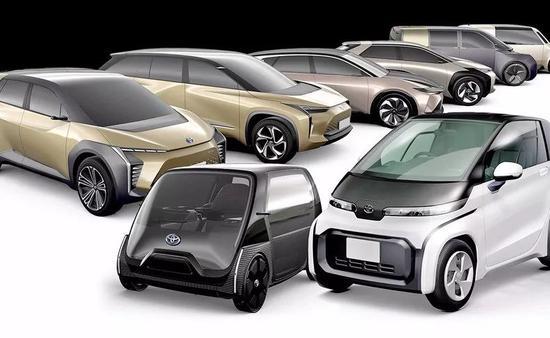
Toyota also plans to roll out a number of battery-powered electric vehicles: a commercial mini-electric quadrangle, a sit-down scooter, a standing scooter and a wheelchair that can be powered by electricity.
The product plans will be from LQ Palette and E-Palette. As planned, both models are expected to hit the streets in time for the 2020 Summer Olympics in Tokyo.
Humphries finished designing models for different uses and classes before submitting the plan to Toyota in March 2019. He said the broad portfolio approach was taken to avoid being overly focused on one type of electric vehicle.
"As for why so many models are being developed at the same time, it is to show that if we have a large number of electric cars, it shows that we have the potential to hold the future," he said.
In a nutshell, Toyota plans to launch 10 battery-powered models worldwide starting in 2020.
04
How to make profits?
The crucial question is how to turn an expensive electric car into a profitable business, a challenge that almost every car company faces in transforming itself. In fact, Toyota is already the world's largest seller of electrified cars, and prius sales remain high. But it took Toyota years to break even on the hybrid.
Toyota's new strategy to profit from the electric-vehicle transition is to rely on partners and new revenue streams.
"As a standalone business, maybe electric cars will never be profitable." "There is a need to develop a fleet of electric vehicles through comprehensive planning," Mr. Toyoshima said.
The goal, he said, is to spread the cost by developing six electric vehicles simultaneously.
To minimize its own investment, Toyota has invited Subaru motor Co., Suzuki Motor Co., Daihatsu Motor Co. and about 20 suppliers to participate in the electric vehicle program.
Their share of the contribution depends largely on how many electric vehicles Toyota expects to eventually sell, Mr Toyoshima said. Moreover, much of their contribution comes in the form of providing staff.
Toyota is also diversifying its partners away from Japanese maker Panasonic Corp. Others include Chinese manufacturers BYD and Ningde Times.
In June, Toyota said it planned to sell about 5.5 million electric vehicles a year globally by 2025, with pure electric vehicles expected to make up less than 1 million vehicles, five years earlier than originally planned.
By extending electrified products to scooters, urban mobility, and mass transportation concepts such as e-Palette, Toyota aims to create an ecosystem of electric vehicles that will allow for scale, reuse, and recycling. The idea is to create a cycle of leasing, sharing, peripheral services and used car sales.
Generating additional revenue this way will be key, said Koji Endo, senior auto analyst at SBI Securities. But how to control the electric car resale price slump is also a big challenge.
"Producing cars is one thing, but the entire battery ecosystem is another," Endo said. As technology improves, batteries get better and cheaper, he notes, "so it's hard and time consuming to get the battery ecosystem to work."
Mr Toyoshima is well aware that this will be the biggest problem. Toyota's brand image has long been tied to its reputation for quality and durability, but that may not be the case for an electric car that has lost half its value.
The goal, Mr. Toyoshima said, is to have a battery that has 90% range and 90% residual value after 10 years of use. But even if it does, Mr Toyoshima admits electric cars are still a long way from becoming profitable.
"It will take at least 10 years." "I don't think electric cars will be profitable until I retire," said the 58-year-old veteran engineer.