How Does Tesla Improve Battery safety
A series of electric vehicle fires have revealed that the safety of Tesla's power battery has yet to be improved.
Tesla released production and sales data showing that it delivered 255,200 electric vehicles in the first three quarters of 2019, already exceeding its sales in the whole of 2018. Among them, the production and sales of The Model 3 Model rose sharply, pushing Tesla to the top of the installed power battery.
However, while the production and sales of ELECTRIC vehicles increased significantly, the fire accidents of electric vehicles also increased rapidly. The main cause was found to be thermal runaway of the battery, which meant that the battery safety problems were prominent.
The so-called thermal runaway is a chain reaction caused by various inducements. The heat can raise the temperature of the battery by thousands of degrees, causing spontaneous combustion. There are three kinds of causes of thermal runaway, which are mechanical electrical, electrochemical and thermal. At present, the vast majority of electric vehicle fires are caused by electrochemically induced thermal runaway.
Because Tesla uses thousands of small cylindrical cells made by Panasonic with high specific energy, the cells are stacked into safe and energy-intensive packs.
In order to achieve higher energy density and achieve fast charging, Tesla has been more aggressive in the design of power battery modules and packs, leading to a significant increase in battery safety risks.
In order to improve the safety performance of power battery, Tesla has been constantly improving its related technologies in recent years and has developed a variety of new technologies to ensure battery safety.
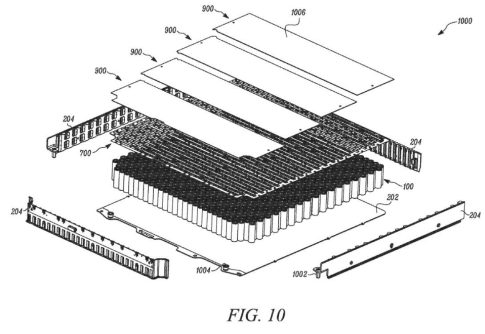
Recently, foreign media reported that Tesla has applied for a new patent for its battery pack design, which uses metal plates to cool the cooling system. This could be the technology tesla uses in its current fixed energy storage products.
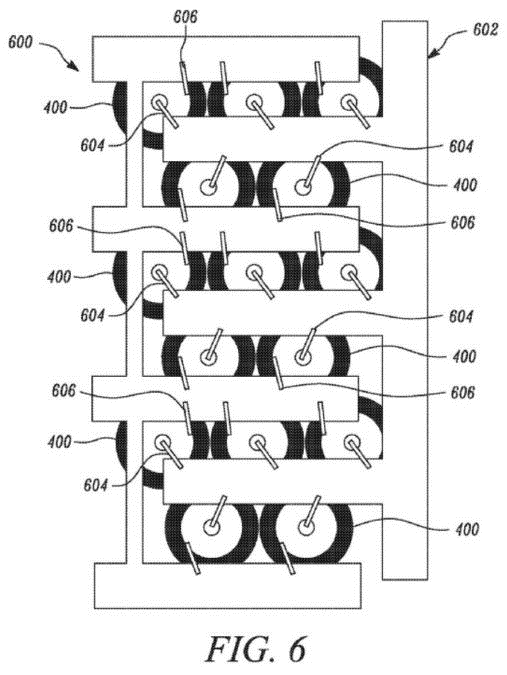
Tesla describes the system in its patent application: the energy storage system consists of a module housing with multiple battery cells located inside the module housing. Each cell has a first end and a second end. In addition, each cell has a positive terminal and a negative terminal.
The first interconnect is located above multiple cell units. A second interconnect is located above multiple cell units. Multiple first cell connectors connect the positive terminal of a cell to the first interconnection.
Similarly, multiple second cell connectors connect the negative terminals of the cell to the second interconnect. The top plate with inner and outer sides is located above the first interconnection piece and the second interconnection piece. The top plate includes one or more weak areas above one or more cell units.
Weak areas are areas of poor integrity, so mechanical failure is more likely if the cell unit releases gas. These areas may be physically weaker than the surrounding areas, and may rupture when pressure increases due to battery failure.
In addition, the weak area may be chemically weaker and the first to rupture when exposed to corrosive gases released by a failed battery unit. Weak areas may also fail due to a combination of physical and chemical weakening.
Here's a drawing of Tesla's new patent application:
值得注意的是,这仅仅是特斯拉保障其电池安全方面的一种。除了电池模组设计之外,特斯拉申请了材料、电芯、电池管理系统等方面新型专利,多层次保障电池安全。
今年8月,特斯拉电池专家Jeff Dahn(杰夫达恩)及其团队发布研究报告称,他们与合作伙伴开发出了一种比固态电池能量密度更高且更稳定的新型锂电池。
该技术报告的全称为:LiDFOB/LiBF4液态电解质无阳极锂金属电池研究报告。
Jeff Dahn与其团队在试验中发现,采用LiDFOB/LiBF4液态电解质的无负极锂金属电池在90次充放电循环后,仍可以剩余80%的电池容量和较高的稳定性,在能量密度上也并不亚于固态电池。
即使在50次充放电循环后,液态电解质也可以实现无密度树枝状的锂形态,包括密集填充的色谱柱。
早些时候,Jeff Dahn及其团队申请了一项名为“锂离子电池电解质浓度成分测定方法和系统”的新专利。
专利申请中写道:本发明提供了一种确定锂离子电池电解质成分浓度的计算机实现法,该方法包括向分光仪发送指令,以抓取电解质溶液的光谱,并生成信号。此外,还将对该信号进行分析,以确定光谱中的一个或多个频谱特征。
所述方法还包括制备一个光谱数据库,该数据库要与预先确定的电解质成分浓度的溶液相对应,其中该数据库还包括每个溶液的多个光谱特征。
而且,该方法还将使用光谱数据库,进一步确定机器学习(ML)模型,将利用该模型确定样品溶液中电解质成分浓度。
2月份,Jeff Dahn团队还申请了一项新电池化学的专利,称其可以为电池提供更快的充电速度、更长的寿命和更低的成本。
该专利名称为“基于双添加电解质系统的新型电池系统”,与依赖更多添加剂的其它系统相比,他们的设计降低了电池成本。此外,双添加电解质系统还可提高锂离子电池的性能和寿命。
该专利申请还表明,新的双添加剂混合物可与锂镍锰钴(NCM正极材料)电池化学品一起使用,这在电动车或电网储能等方面都会发挥作用。
1月份,特斯拉最近发布了一项名为“冗余电池管理系统”电池技术专利,具有客户端和多通道、双向、菊花链通信环路。特斯拉还列出了电池管理系统中的故障和定位方法。
去年8月,特斯拉还申请了一项新专利,通过隔离有缺陷的电芯,防止其对功能正常的电芯产生负面影响,进而提高电池的安全性。